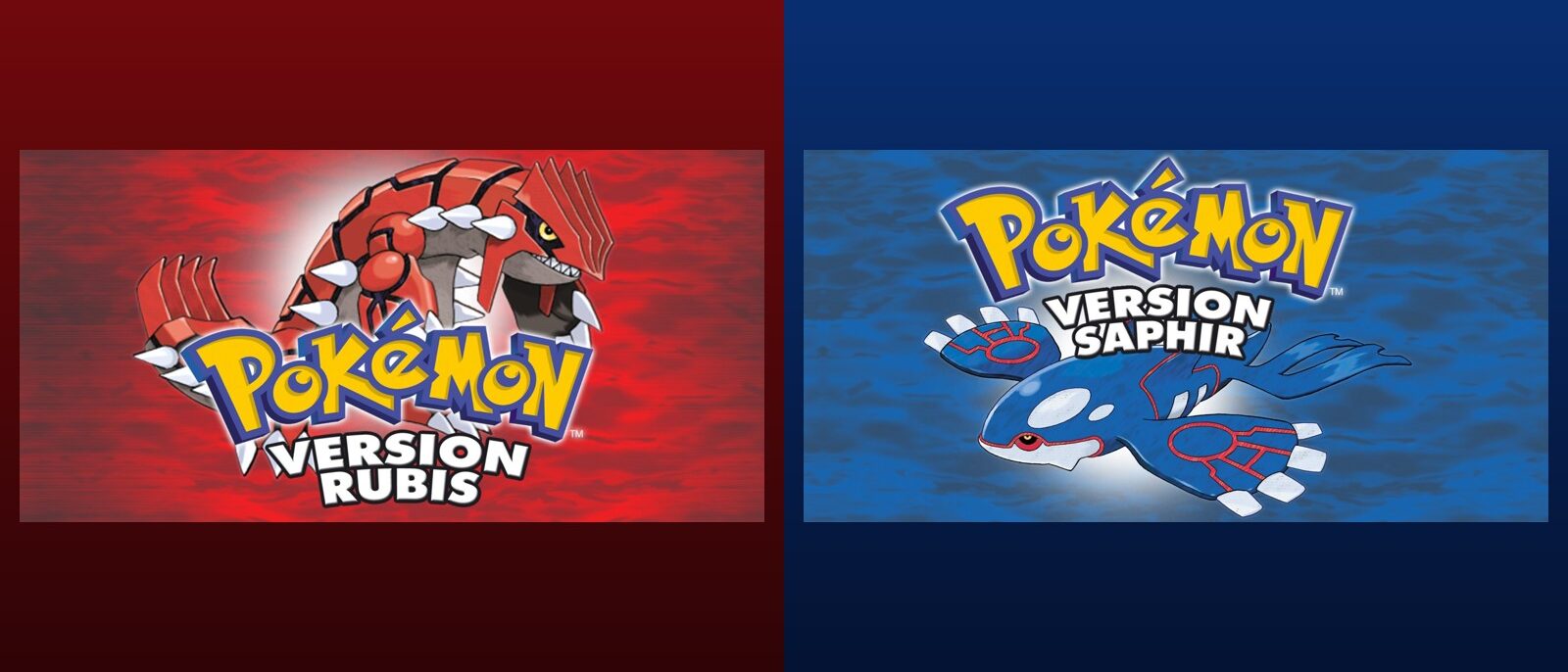
On July 25, 2003, French players discovered Hoenn on the Game Boy Advance with Pokémon Ruby Version and Sapphire Version, followed two years later by Emerald Version. More than twenty years on, this third generation remains one of the most influential in the series: Abilities, Natures, Double Battles, Contests… A good part of what makes Pokémon what it is today was born there. A look back at a generation that reset everything.
2002-2003: the generation that took a gamble
Pokémon Ruby Version and Sapphire Version were released in Japan on November 21, 2002, then in North America on March 19, 2003 and in Europe on July 25, 2003. Developed by Game Freak for the Game Boy Advance, they introduced a new region, Hoenn, inspired by the Japanese island of Kyūshū but rotated by 90 degrees to better fit the console’s widescreen display. The games brought 135 new Pokémon, raising the total to 386, with two opposing Legendary Pokémon as the stars:  Groudon, master of the land, on the cover of Ruby, and
 Kyogre, lord of the seas, on the cover of Sapphire.
The context was far from straightforward, though. Interviewed by Game Informer magazine in 2017, Junichi Masuda explained that Ruby and Sapphire were the most difficult games to develop: at the time, many predicted that the Pokémon craze was running out of steam, and the team felt strong pressure to prove otherwise. Mission accomplished: according to Nintendo, the two versions had sold 16.22 million copies worldwide by March 2013, making them the best-selling games on the Game Boy Advance.
This fresh start came at a price, and no small one: it was impossible to transfer your Pokémon from Red, Blue, Yellow, Gold, Silver or Crystal. Game Boy and Game Boy Advance cartridges cannot communicate with each other, so players had to start again from scratch. It was a painful choice at the time, but it allowed the rules of the game to be rebuilt from the ground up.
Abilities, Natures, potential: the foundations of the modern game
If the third generation matters so much, it is first of all because of what it changed under the hood. Three new features, all still present today, transformed the way teams are built:
- Abilities, which were still called “special abilities” in this generation. Every Pokémon now has a passive power that can change the course of a battle: Intimidate, Levitate, Drizzle…
- Natures: twenty-five in total. Most of them raise one stat by 10% and lower another by the same amount. Two Pokémon of the same species are no longer necessarily equal.
- Reworked potential and effort points: Individual Values (IVs) go from a 0 to 15 scale to a 0 to 31 scale, and Effort Values (EVs) are now capped at 255 per stat and 510 in total. This is the system that competitive players still use as their foundation, more than twenty years later.
Together, these three mechanics turned Pokémon from a game where you simply train your favorites into a strategy game where every detail counts. Competitive Pokémon as we know it, with its analyses and optimized teams, was born in Hoenn.
Double Battles were born in Hoenn
Another revolution, and a more visible one: Double Battles. In Ruby and Sapphire they remain rare, as in the duel against the twins Tate and Liza, the Gym Leaders of Mossdeep City. But the idea was launched, and Emerald developed it extensively, even having you face two different Trainers at the same time. This two-on-two format has become the one used in official video game competitions: the Pokémon World Championships are now played in Doubles, these days on Pokémon Champions.
Weather takes on a new dimension too. Rain and sun had existed in battle since the second generation, but Hoenn adds hail and, above all, weather that shows up on the map: permanent rain around Fortree City, a sandstorm near Lavaridge Town. And some Pokémon trigger it by themselves: Kyogre with its ability Drizzle, Groudon with Drought. These two Legendary Pokémon were, in fact, the only ones to have such an ability in this generation, and their clash over the climate is at the heart of the story.
Contests, Secret Bases, Dive: a world to live in
Hoenn is not just a region to cross from Badge to Badge. Ruby and Sapphire multiply the side activities that make you want to linger:
- Pokémon Contests: five categories (Cool, Beauty, Cute, Smart, Tough) and four ranks, from Normal to Master. You prepare your Pokémon for them with Poké Blocks, made from Berries in a Berry Blender. These are also the first games to hand out Ribbons.
- Secret Bases: thanks to the move Secret Power, you set up your hideout in a tree or a rock wall, with up to sixteen decorations. After a data exchange, your friends’ bases appear in your own game.
- Dive: in certain spots, the sea opens up to an underwater world, a first for the series.
- Berries to grow, which grow in real time thanks to the cartridge’s clock, the Running Shoes that finally let you run, and the PokéNav, which brings together the map, your Pokémon’s status and rematches against Trainers.
Hoenn is also full of secrets that delighted playgrounds everywhere.  Feebas, for example, can only be fished up on six of the 444 water tiles of Route 119, and those tiles change regularly. To evolve it into
 Milotic, you have to raise its Beauty with Poké Blocks, a unique method. As for Mirage Island, it only appears on certain days, based on a daily random draw tied to the Pokémon in your party, a rarity that fueled plenty of playground legends. Not to mention the Regi puzzle: you had to decipher Braille inscriptions to awaken
 Regirock,
 Regice et
 Registeel.
Emerald, the definitive version
Like Yellow and Crystal before it, Pokémon Emerald Version revisits the adventure. Released in Japan on September 16, 2004, it arrived in France on October 21, 2005. This time, Team Magma and Team Aqua are both involved and fight each other, while  Rayquaza, guardian of the sky, becomes the pivot of the story and can be caught before the League. All the Gyms are modified: Juan takes over the one in Sootopolis City, and Wallace becomes the League Champion, in place of Steven Stone, whom you meet after the credits.
But Emerald’s big new feature is the Battle Frontier, which replaces the Battle Tower of Ruby and Sapphire. It has seven facilities, each with its own rules and a Frontier Brain to defeat in order to earn its Symbols. It is a true post-game designed for the most demanding players, and the ancestor of all the challenge zones in the following games.
| Facility | Frontier Brain |
|---|---|
| Battle Tower | Anabel |
| Battle Dome | Tucker |
| Battle Factory | Noland |
| Battle Arena | Greta |
| Battle Pike | Lucy |
| Battle Palace | Spenser |
| Battle Pyramid | Brandon |
Emerald also reintroduces animated sprites in battle and adds wireless connectivity with FireRed and LeafGreen. The result: more than 6 million copies sold according to Nintendo, and a reputation as the go-to version for reliving Hoenn on the Game Boy Advance.
From Omega Ruby and Alpha Sapphire to today: the legacy
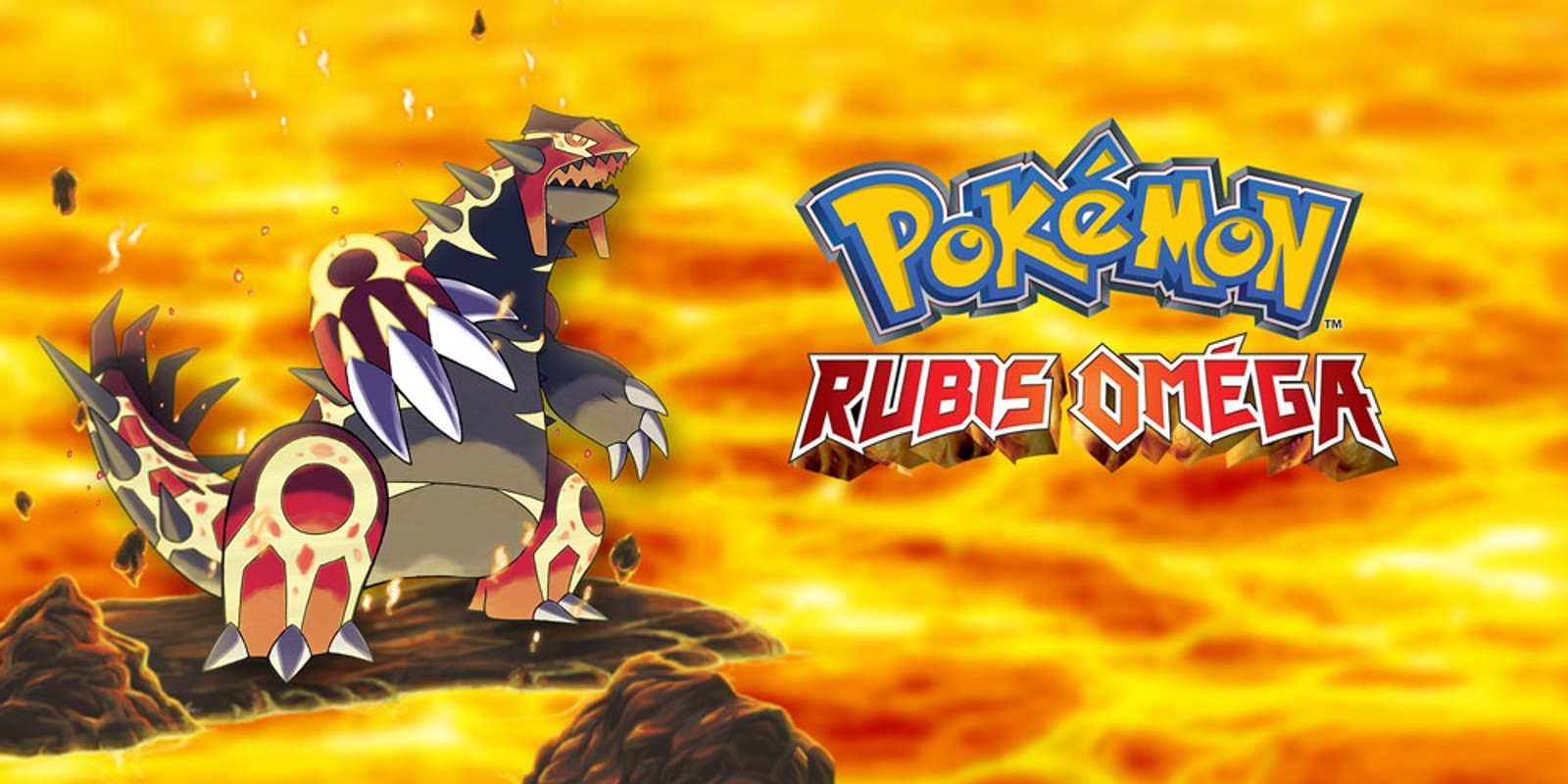
Hoenn got a second youth with Pokémon Omega Ruby and Pokémon Alpha Sapphire, released on Nintendo 3DS on November 28, 2014 in Europe. These remakes add Primal Reversion, which turns Groudon and Kyogre into Primal Groudon and Primal Kyogre, new Mega Evolutions, and a brand-new sequel, the Delta Episode, centered on Mega Rayquaza and the threat of an asteroid. You can even fly over Hoenn thanks to Soaring, granted by the Eon Flute. According to Nintendo, they have passed 14.6 million copies.
Hoenn’s footprint goes well beyond its games. On television, season 6 of the anime, “Advanced,” sends Ash to Hoenn alongside Brock, May and her little brother Max, and opens an era that would last until “Battle Frontier.” In the cinema,  Jirachi and then
 Deoxys each got their own movie. In Pokémon GO, the arrival of the Hoenn Pokémon in December 2017 came with real-time weather, a nod to the ideas of Ruby and Sapphire, and the Pokémon GO Tour: Hoenn in February 2023 saw the debut of Primal Groudon and Primal Kyogre.
Key takeaways
Ruby, Sapphire and Emerald took a rare risk: starting over from zero at the height of success. In return, they laid the foundations the series still uses today, from Abilities to Natures to the Double Battles that structure all of competitive play. If you feel like rediscovering Hoenn, our complete walkthrough of Pokémon Ruby, Sapphire and Emerald guides you step by step, from Contests and Poké Blocks to the Battle Frontier, including catching the Legendary Pokémon and the secrets of Hoenn.
Sources: official Nintendo pages for Pokémon Ruby Version and Pokémon Emerald Version; Nintendo of America press release of October 15, 2013; Nintendo sales figures; Junichi Masuda’s interview with Game Informer; Poképédia.