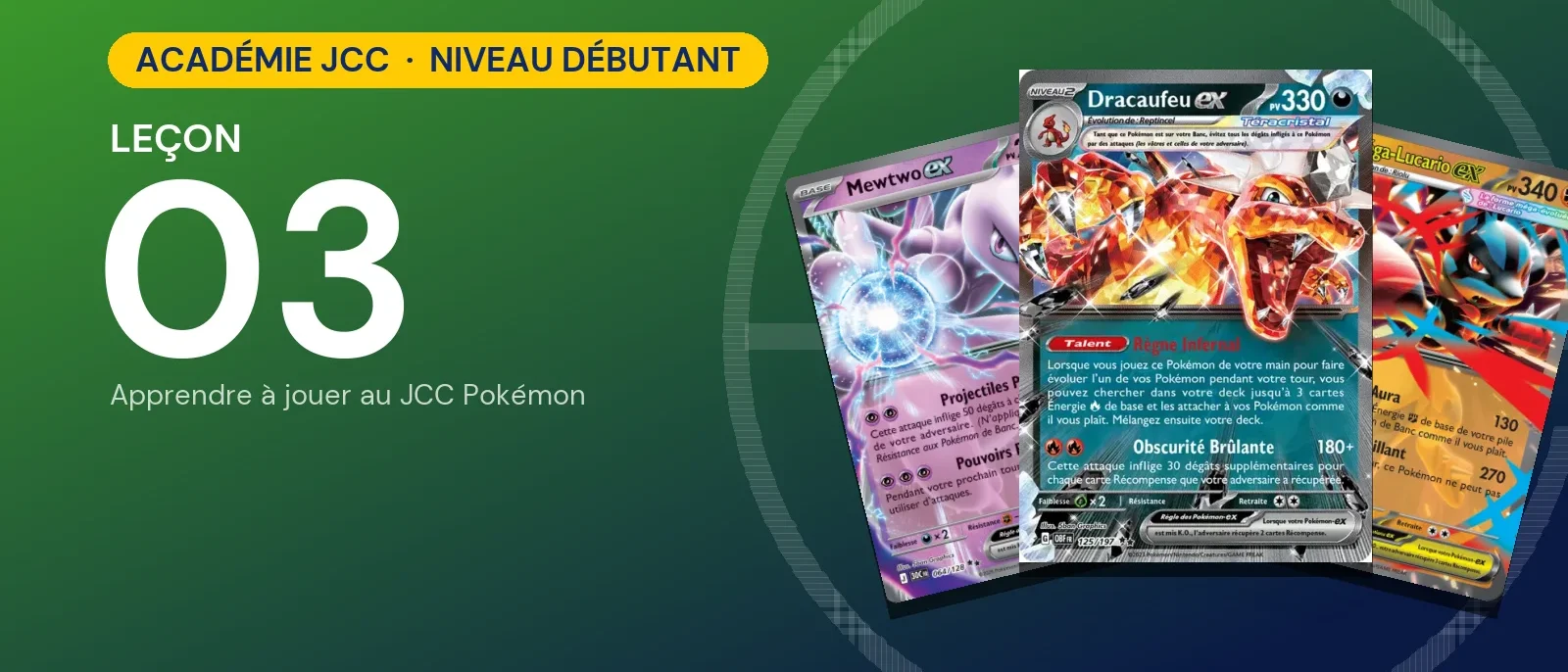
A Pokémon card packs a lot of information into very little space. Good news: the layout is always the same. Once you know where to look, you can read an unfamiliar card in a few seconds, including the one your opponent has just played in front of you.
The anatomy of a Pokémon card
Let’s take the Mewtwo ex from the 30th Celebration expansion. Hover over or tap the numbered landmarks to link the card with the explanations.
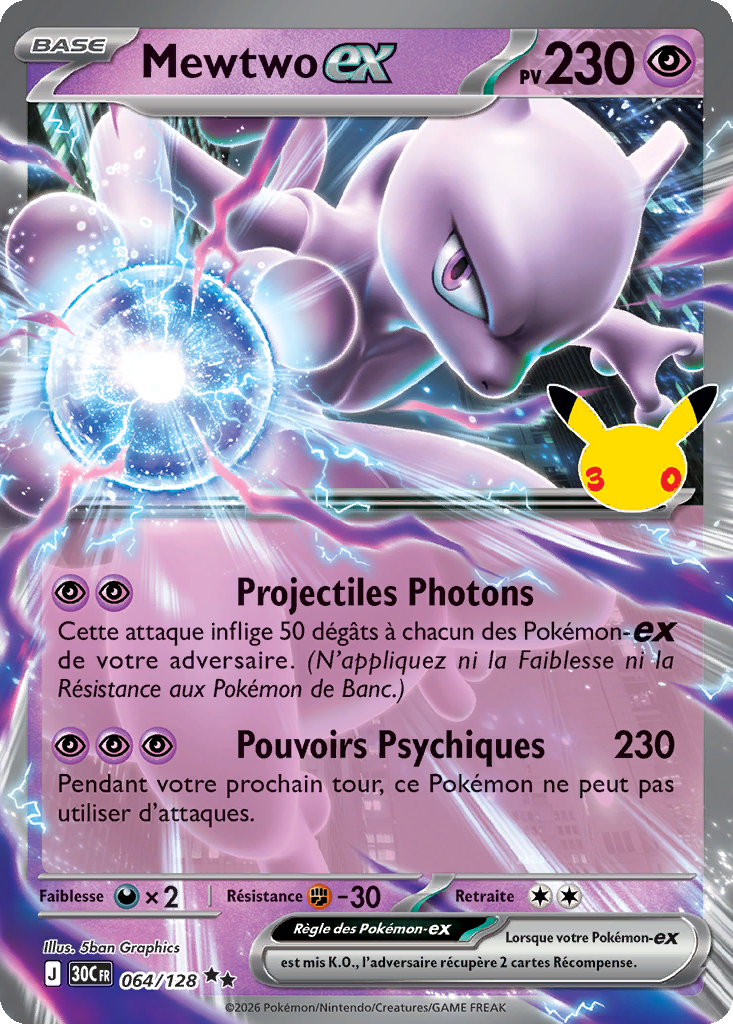
- 1Niveau d'évolution BASE, NIVEAU 1 ou NIVEAU 2. Une carte de base se pose directement en jeu ; les autres évoluent depuis le Pokémon indiqué.
- 2Nom Le « ex » signale un Pokémon-ex : plus puissant, mais il rapporte 2 cartes Récompense à l'adversaire.
- 3Points de vie (PV) Quand les dégâts reçus atteignent ce total, le Pokémon est mis K.O.
- 4Type Le type du Pokémon, qui compte pour la Faiblesse et la Résistance des adversaires.
- 5Coût d'attaque Les Énergies à avoir attachées au Pokémon pour lancer l'attaque. Elles ne sont pas défaussées.
- 6Nom d'attaque Une seule attaque par tour, et elle termine votre tour.
- 7Effet Le texte prime toujours sur les règles générales. Lisez-le jusqu'au bout.
- 8Dégâts Les dégâts de base, avant Faiblesse et Résistance.
- 9Faiblesse Si l'attaquant est de ce type, les dégâts sont doublés (×2).
- 10Résistance Si l'attaquant est de ce type, les dégâts sont réduits de 30.
- 11Coût de Retraite Le nombre d'Énergies à défausser pour renvoyer ce Pokémon sur le Banc.
- 12Encadré Règle Une règle propre à la carte : ici, les 2 cartes Récompense des Pokémon-ex.
- 13Illustrateur L'artiste qui a dessiné la carte.
- 14Marque de règlement La lettre qui détermine dans quels formats de tournoi la carte est autorisée.
- 15Extension et numéro Le code de l'extension et le numéro de la carte dans la série.
- 16Rareté Le symbole de rareté (ici ★★, double rare).
Let’s read this Mewtwo ex together: it’s a Basic Pokémon of Psychic type with 230 HP. Its first attack, Photon Bullets, costs two Psychic Energy and deals 50 damage to each of the opponent’s Pokémon ex. Its second, Psychic Powers, costs three Psychic Energy and deals 230 damage, but prevents it from attacking on the following turn. It is weak to Darkness type (damage doubled), resistant to Fighting type (30 less damage), and its Retreat Cost is two Energy.
Evolution stages
At the top left, each Pokémon card shows its stage:
- Basic Pokémon: it is played directly onto the Bench or the Active Spot.
- Stage 1: it is placed on the Basic Pokémon it evolves from (the name is shown on the card).
- Stage 2: it is placed on the matching Stage 1 Pokémon.


A Pokémon that evolves keeps its damage and attached cards (Energy, Tool), but recovers from its Special Conditions. It takes the HP, attacks and Weakness of its new card. The cards of the previous forms stay underneath and go with it to the discard pile if it is Knocked Out.
Pokémon ex and Mega Evolution
Some Pokémon carry the ex label. More HP, stronger attacks… but a price to pay, spelled out in the Rule Box at the bottom of the card: when your Pokémon ex is Knocked Out, your opponent takes 2 Prize cards instead of one.
The Mega Evolution series brought back Mega Evolution Pokémon ex, even more powerful. They give your opponent 3 Prize cards. They follow the normal evolution rules: Mega Lucario ex evolves from Riolu, for example.


Types and Energy
The TCG has eight basic Energy types, plus one special symbol:
- Grass
- Fire
- Water
- Lightning
- Psychic
- Fighting
- Darkness
- Metal
- Incolore
- A type symbol in an attack cost must be paid with an Energy of that type.
- The Colorless symbol (a white star) can be paid with any Energy.
- Dragon-type Pokémon have no dedicated Dragon Energy: their attacks generally combine several types.
- The Fairy type disappeared from the TCG in 2020: recent Fairy Pokémon are Psychic type.
Recognizing a Trainer or Energy card
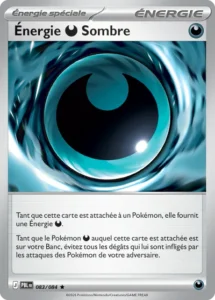
A Trainer card shows its category at the top: Item, Supporter, Stadium or Pokémon Tool. At the bottom, a reminder of the rule that applies to it (for example, only one Supporter per turn). Energy cards are either Basic (no text, as many as you like in a deck) or Special, with their own effect in addition to the Energy they provide.


The bottom of the card: the regulation mark
At the very bottom left, a small letter in a box (“J” on our Mewtwo ex): that’s the regulation mark. It indicates whether the card is allowed in the Standard tournament format, which accepts only recent cards. Next to it are the expansion code, the card number and its rarity symbol. To play with friends, you can ignore this letter; for tournaments, head to lesson 9.
Testez-vous
What is special about a Pokémon ex?
It gives your opponent 2 Prize cards when it is Knocked Out (3 for a Mega Evolution Pokémon ex).
What can you pay a Colorless symbol with in an attack cost?
With any type of Energy.
Does a Pokémon that evolves lose its damage?
It keeps them: the damage and attached cards stay. However, it recovers from its Special Conditions.
What does the Retreat Cost mean?
The number of Energy you must discard to send this Active Pokémon back to the Bench.