
Playing with a ready-to-play deck is fine for learning. Building your own is where the TCG becomes truly exciting. But faced with thousands of cards, where do you start? This lesson gives you a six-step method and a sample skeleton to avoid the classic pitfalls of a first deck.
The deck-building rules
- Exactly 60 cards.
- A maximum of 4 copies of the same card, meaning cards with the same name. Exception: Basic Energy cards, in unlimited numbers.
- Only one ACE SPEC card per deck.
- At least one Basic Pokémon, obviously… and in practice many more, as lesson 7 shows.
The right balance
There is no magic formula, but most current decks revolve around this balance:
- 15 Pokémon
- 35 Dresseurs
- 10 Énergies
Why so many Trainers? Because a deck doesn’t win thanks to its strongest Pokémon, but thanks to its ability to find them and set them up in time. That is the job of draw and search cards.
The 6-step method
1. Choose your main attacker
Start from a Pokémon whose attack you like and that deals enough damage to Knock Out Pokémon ex in one or two hits. The whole deck will be built to get it into play, power it with Energy and make it attack as often as possible.
2. Build its evolution lines
The lower a Pokémon is in the line, the more copies you need: it has to come out early, and it can be Knocked Out before evolving.
- For a Stage 2: a 4-3-3 line (4 Basic, 3 Stage 1, 3 Stage 2) is a good start. With Rare Candy, you can often go down to 4-2-3.
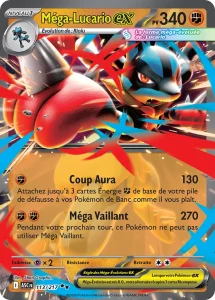
- For a Stage 1 (such as a Mega that comes from a Basic Pokémon): 4-3 or 3-3.
- For a Basic Pokémon: 3 or 4 copies.

3. Add a secondary attacker and support
A second attacker covers the bad matchups (an opposing type that resists yours, for example). Support Pokémon, for their part, almost never attack: they have Abilities that draw cards, search for cards or accelerate Energy. Two or three are enough.
4. Build your draw and search engine
This is the heart of the deck, the part beginners always underestimate:
- Draw Supporters (Professor’s Research, Iono…): around 8 to 10.
- Search Items (Ultra Ball, Nest Ball…): 6 to 8.
- Mobility (Switch…): 2 or 3, to get a stuck Pokémon out.
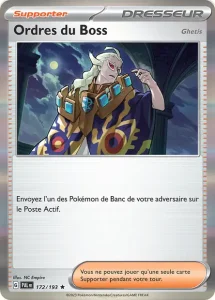
- Boss’s Orders: 2 to 3, to pick your target at the right moment.


5. Count your Energy
Start with 8 to 12 Energy. Go up toward 12 if your attacks are expensive and nothing helps you attach more than one Energy per turn. Go down toward 8 if Abilities or cards accelerate your Energy. Avoid mixing more than two types: it’s a recipe for stuck hands.
6. Test, take notes, adjust
Play at least about ten games before judging. Note what you often lack, and the cards that stay stuck in your hand. Then change one or two cards at a time: otherwise, there’s no way to know what made the difference.
A sample skeleton, card by card
Here is what the structure of a deck built around a Stage 1 Mega Pokémon ex looks like. The roles matter more than the precise names: adapt them to the cards you own.
| Role | Contents | Cards |
|---|---|---|
| Main attacker | 4 Basic Pokémon + 3 Mega | 7 |
| Secondary attacker | A solid Basic Pokémon with a different profile | 2 |
| Support | Pokémon with a draw or search Ability | 4 |
| “Tech” cards | Answers to a specific problem | 2 |
| Draw Supporters | Professor’s Research, Iono… | 8 |
| Other Supporters | Boss’s Orders ×2, a healing or recovery Supporter ×2 | 4 |
| Search Items | Ultra Ball, Nest Ball… | 8 |
| Mobility and recovery | Switch, recovering discarded cards… | 8 |
| Tools, Stadium, ACE SPEC | Depending on the game plan | 7 |
| Energy | Basic Energy of the attacker’s type | 10 |
| Total | 60 |
Testez-vous
How many copies of the same card can you put in a deck?
4 copies of a card with the same name, except Basic Energy cards, which are unlimited.
What evolution line is recommended for a Stage 2 Pokémon?
A 4-3-3 line: 4 Basic Pokémon, 3 Stage 1 and 3 Stage 2 (or 4-2-3 with Rare Candy).
How much Energy should you plan for to start?
Roughly between 8 and 12, depending on attack costs and the means of acceleration.
How many cards should you change with each adjustment?
One or two at a time, to know precisely what improves (or worsens) the deck.
À toi de jouer
Construis ton deck de 60 cartes
Le deck builder applique ces règles pendant que tu construis : compteur de 60 cartes, 4 exemplaires au maximum, chances de piocher un Pokémon de base en main de départ.