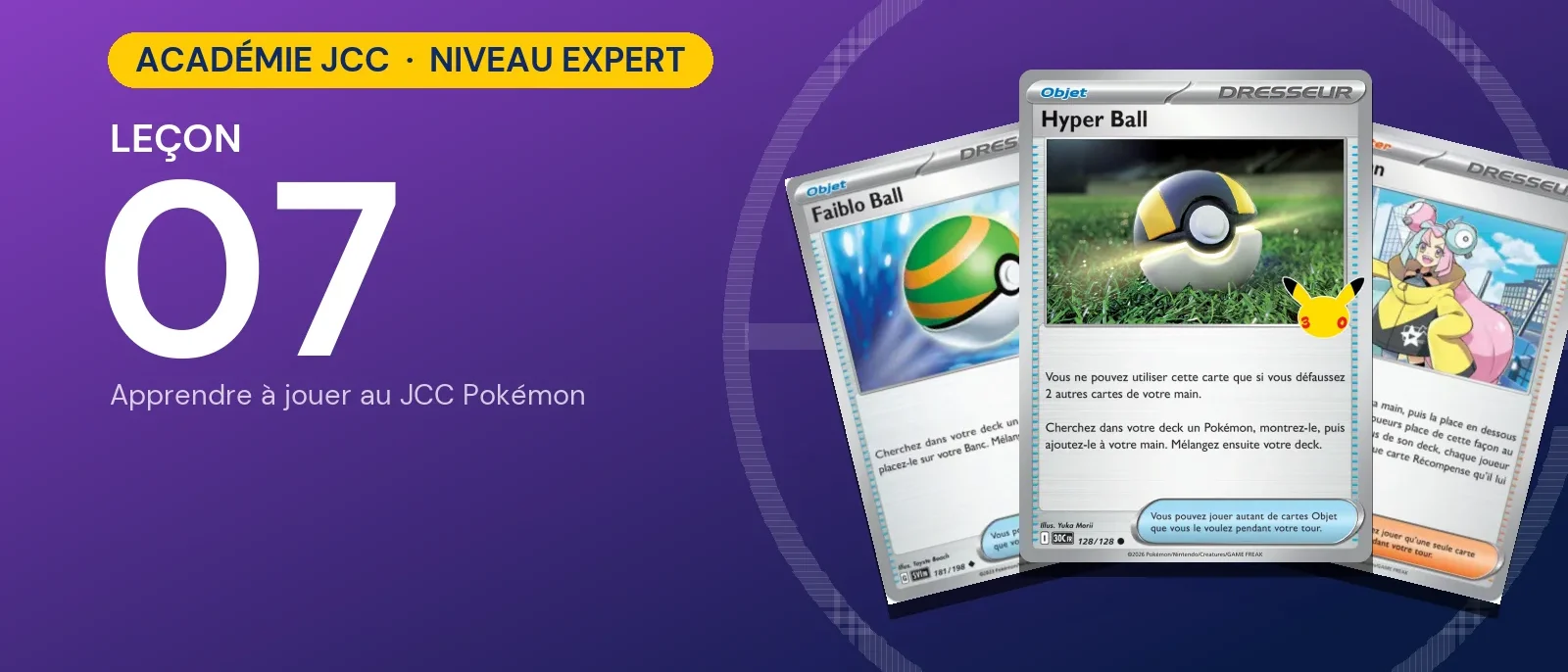
The best players don’t win because they’re lucky: they build decks that need luck as little as possible. That’s what we call consistency, a deck’s ability to carry out its plan game after game. And it can be measured, with a little probability. Don’t panic: there are no formulas to memorize, the tables and the calculator do the work.
The mulligan: how many Basic Pokémon?
A starting hand with no Basic Pokémon is a mulligan, and a free card for your opponent. Here is the probability of having at least one Basic Pokémon in your first 7 cards, depending on how many are in the deck:
| Pokémon de base dans le deck | Main de départ jouable | Risque de mulligan |
|---|---|---|
| 6 | 54.1 % | 45.9 % |
| 8 | 65.4 % | 34.6 % |
| 10 | 74.1 % | 25.9 % |
| 12 | 80.9 % | 19.1 % |
| 14 | 86.1 % | 13.9 % |
| 16 | 90.1 % | 9.9 % |
With 10 Basic Pokémon, you’ll mulligan about one game in four. With 12, about one in five. That’s why most decks play at least around ten Basic Pokémon, including support Pokémon that will never attack.
How many copies of a key card?
On the first turn, you’ve seen 7 cards (your hand), or 8 if you draw. Here is the chance of having at least one copy of a card among those 8 cards:
- 4 copies: about 44.5%.
- 3 copies: about 35.4%.
- 2 copies: about 25.1%.
- 1 copy: about 13.3%.
Even when played as a 4-of, a card is in hand on the first turn only about half the time. That’s why it matters not to count on one specific card, but on a set of cards that fill the same role.
The probability calculator
The same calculation works in the middle of a game: enter how many cards are left in your deck, how many useful copies are in it, and how many cards you’re going to see (for example 7 with Professor’s Research).
Chance de voir au moins un exemplaire. Exemple : 4 Hyper Ball dans un deck de 60, main de 7 cartes.
“Outs”: count everything that saves you
Players talk about outs: all the cards that solve your problem of the moment. Are you looking for your main attacker? Your outs aren’t just its 3 copies, but also your 4 Ultra Ball, which can go and fetch it. That’s 7 outs instead of 3, and a completely different probability.
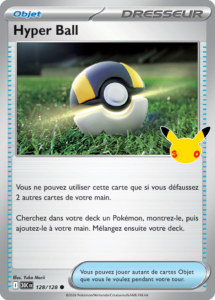
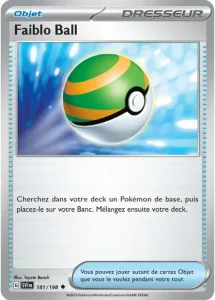
That’s the whole point of search cards: they multiply your outs. An Ultra Ball counts as an extra copy of each of your Pokémon.
Cards stuck in the Prize cards
Six cards from your deck are set aside at the start, at random. So each card has a 10% chance of ending up in your Prize cards. Depending on the number of copies played:
| Exemplaires dans le deck | Au moins 1 dans les Récompenses | Tous dans les Récompenses |
|---|---|---|
| 1 | 10.0 % | 10.0 % |
| 2 | 19.2 % | 0.8 % |
| 3 | 27.5 % | < 0,1 % |
| 4 | 35.1 % | < 0,1 % |
A card played as a single copy is stuck one game in ten, and there’s nothing you can do about it until you take the right Prize card. With 4 copies, the risk of losing at least one rises to 35%, but the risk of losing all of them becomes almost nil. That’s why essential cards are played in multiple copies.
Seeing more cards, faster
The conclusion from all these numbers is simple: consistency comes from the number of cards you see each turn. Draw Supporters, draw Abilities and search cards increase that number. A deck that sees 15 cards by its second turn has a 69% chance of running into a card played as a 4-of; a deck that sees only 9 falls below 50%.
Testez-vous
With 10 Basic Pokémon in the deck, how often do you mulligan?
About 26% of games, or one in four.
What is the probability that a card played as a single copy is in the Prize cards?
10%, since 6 cards out of 60 are set aside at random.
What are “outs”?
All the cards that solve the problem of the moment, including search cards able to fetch the card you want.
When should you check which cards are in your Prize cards?
The first time you search your deck: you spot the missing key cards, which are therefore in your Prize cards.