At the Expert level, you stop seeing a game as a series of attacks. You see it as a race to six Prize cards, where every Knock Out is a transaction: how many do I take, how many do I give back. English-speaking players call this the “prize trade”. Mastering it means knowing from the start of the game how you’re going to win it.
Six Prizes, several paths
Each Knocked Out Pokémon earns 1, 2 or 3 Prize cards. There are therefore several ways to reach six:
- Six Pokémon « simples »6 K.O. à réaliser : long, mais chaque perte vous coûte peu.
- Trois Pokémon-ex3 K.O. suffisent. Le chemin le plus courant.
- Deux Pokémon-ex Méga2 K.O. seulement : les Méga sont des cibles en or.
- Un plan mixteLe vrai jeu : choisir l'ordre de vos K.O. pour finir pile à 6.
The question to ask yourself constantly: how many Knock Outs do I still need, and how many does my opponent need? The player who needs fewer winning attacks is ahead, even if they’ve taken fewer Prizes so far.
Two philosophies: single-Prize versus ex
- Pokémon ex and Mega decks hit hard and take a lot of punishment, but each of their Knocked Out Pokémon costs 2 or 3 Prizes. They have to win in few trades.
- “Single-Prize” Pokémon decks (with no Rule Box) force the opponent to make six Knock Outs. Each Pokémon lost costs only one Prize, but they often need several of them to take down a big Pokémon ex.
Planning your Knock Outs: the “Prize map”
Look at your opponent’s side of the field and do the math. Your opponent has a Mega Darkrai ex in the Active Spot (3 Prizes), a Pokémon ex on the Bench (2) and a single-Prize Pokémon (1). You have 6 Prizes left to take.
- Plan A: Knock Out all three, in the order that suits you: 3 + 2 + 1 = 6. Three winning attacks are enough.
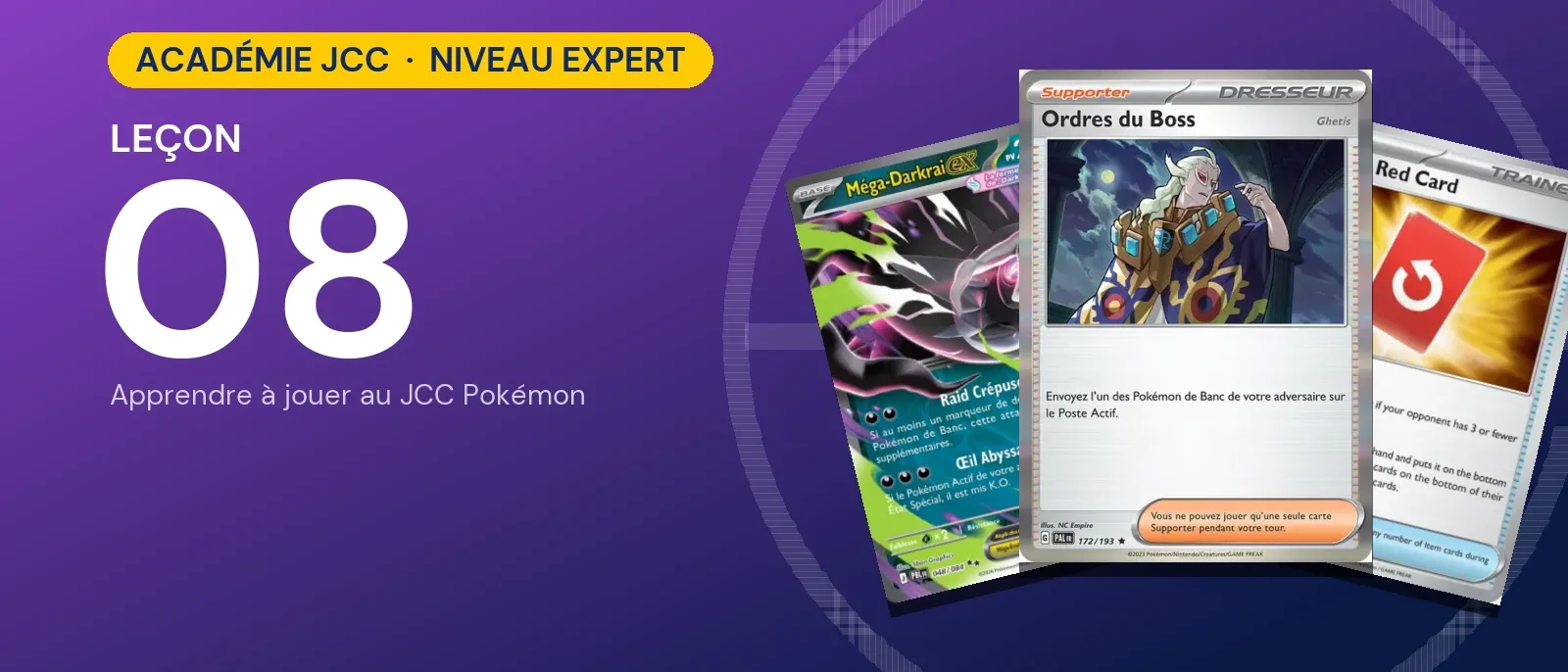
- If your attacker can’t reach the Mega’s 280 HP, start with the Benched Pokémon ex using Boss’s Orders, then keep something in reserve to finish the job.


That’s the whole point of Boss’s Orders: not putting up with the Pokémon your opponent presents to you, but going to get the one that brings you closest to victory fastest. Keep one for the decisive Knock Out.
One hit or two?
Before each attack, ask yourself whether you’ll Knock your target Out in one hit or two hits. An opponent who Knocks you Out in one hit while you need two attacks wins the race. The solutions: a Tool that increases your damage, a first hit on the Bench, a Special Condition, or another target.
Managing your Bench
- Don’t play Pokémon ex needlessly: each one is a 2- or 3-Prize target for an opposing Boss’s Orders.
- Always prepare the replacement: a Benched Pokémon with Energy attached, ready to take over after a Knock Out.
- Keep some room: a full Bench stops you from playing the Pokémon you’ll need later.
When you’re behind: comeback cards
Some cards are designed for the player who is behind on Prizes. Iono makes each player draw according to their remaining Prizes: at 6 against 2, you draw 6 cards and your opponent only 2. Special Red Card, which can be played only if your opponent has 3 or fewer Prizes remaining, sends their hand back under their deck and leaves them with only 3 cards.


Testez-vous
What is the best indicator of who is really ahead in a game?
The number of Knock Outs still to make on each side, more than the number of Prizes already taken.
Why avoid putting a Pokémon ex on the Bench for no reason?
It offers a 2- or 3-Prize target that the opponent can go and get with Boss's Orders.
Facing a Mega (3), an ex (2) and a single-Prize Pokémon (1), how do you take exactly 6 Prizes?
Knock Out the Mega (3), the Pokémon ex (2) and the single-Prize Pokémon (1), for three winning attacks.
How many Knock Outs are needed against a deck of single-Prize Pokémon?
Six: a single-Prize Pokémon is worth only one Prize.