Knowing whether an attack Knocks Out or leaves the opponent at 10 HP is often what separates a win from a loss. This lesson gives you the two tools you need to never get it wrong again: Special Conditions, which deal damage between turns, and the exact order of damage calculation.
The five Special Conditions
Some attacks affect the opposing Active Pokémon with a Special Condition. Only an Active Pokémon can be affected by one. Three of them are shown by turning the card, the other two with a marker:
 EndormiCarte tournée vers la gaucheNe peut ni attaquer ni battre en retraite. Au Contrôle Pokémon, lancez une pièce : face, il se réveille.
- ParalyséCarte tournée vers la droiteNe peut ni attaquer ni battre en retraite. Guérit au Contrôle Pokémon qui suit votre prochain tour.
- ConfusCarte tête en basPour attaquer, lancez une pièce : pile, l'attaque échoue et il reçoit 3 marqueurs de dégâts.
- EmpoisonnéMarqueur Poison1 marqueur de dégâts (10 dégâts) à chaque Contrôle Pokémon.
- BrûléMarqueur Brûlure2 marqueurs de dégâts (20 dégâts) à chaque Contrôle Pokémon, puis lancez une pièce : face, il guérit.
This difference has a direct consequence:
- Asleep, Paralyzed and Confused are mutually exclusive: the card can only have one orientation. An Asleep Pokémon that becomes Paralyzed is no longer Asleep.
- Poisoned and Burned stack with each other and with the other three. A Pokémon can be Paralyzed, Poisoned and Burned at the same time.
The Pokémon Checkup
Between the end of one turn and the start of the next, you check the Special Conditions of both Active Pokémon, always in this order:
- 1. Empoisonné+1 marqueur
- 2. Brûlé+2 marqueurs puis pièce
- 3. Endormipièce : face = réveil
- 4. Paralységuérit si son tour vient de passer
Puis les Pokémon dont les PV sont épuisés sont mis K.O., et le tour passe à l'adversaire.
Poison and Burn damage is applied at every Pokémon Checkup, so after each player’s turn. A Poisoned Pokémon therefore takes 10 damage after your turn, then another 10 after your opponent’s.
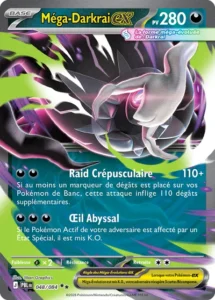
Weakness and Resistance
- Weakness: if the attacking Pokémon is of the indicated type, the damage is doubled.
- Resistance: if the attacking Pokémon is of the indicated type, the damage is reduced by 30.
Two essential points: Weakness and Resistance only apply to damage done by an attack to the Active Pokémon. Damage to Benched Pokémon is not modified. And an attack that tells you to “put damage counters” doesn’t deal “damage”: Weakness, Resistance and effects that protect against damage don’t apply.
The order of damage calculation
- The base damage of the attack, with the bonuses provided by its text (“+110 damage if…”).
- Effects on the attacker: Tools, Abilities, cards played this turn that increase damage.
- The defender’s Weakness: ×2.
- The defender’s Resistance: −30.
- Effects on the defender: damage reductions, protections.
The result is translated into damage counters (one counter per 10 damage). If the total reaches the defender’s remaining HP, it is Knocked Out.
Your turn to play: the calculator
Change the values to recreate the example above, then test your own game situations.
Testez-vous
Which Special Conditions are mutually exclusive?
Asleep, Paralyzed and Confused, because they are shown by the orientation of the card. Poisoned and Burned stack with all the others.
In what order do you apply Weakness and Resistance?
Weakness (×2), then Resistance (−30).
Does Weakness apply to damage dealt to Benched Pokémon?
No: they only concern damage dealt to the Active Pokémon.
How can a Paralyzed Pokémon be cured during your turn?
By evolving or returning to the Bench, for example with the Switch card, since it can't retreat.