You know the equipment and the goal of the game. Time for action! A game of the Pokémon TCG always follows the same ritual: a setup in a few steps, then turns that alternate between the two players. Once you’ve absorbed this rhythm, you can focus on what matters: strategy.
Before the game: setup
- 1MélangezSerrez-vous la main, puis mélangez chacun votre deck de 60 cartes.
- 2Pile ou faceLe gagnant du lancer de pièce choisit qui commence.
- 3Piochez 7 cartesC'est votre main de départ.
- 4Placez vos PokémonUn Pokémon de base face cachée sur le Poste Actif, et jusqu'à 5 autres sur le Banc.
- 5Pas de Pokémon de base ?Mulligan : montrez votre main, mélangez-la dans le deck et repiochez 7 cartes. Votre adversaire peut piocher 1 carte de plus par mulligan.
- 6Posez 6 RécompensesLes 6 cartes du dessus de votre deck, face cachée. Retournez vos Pokémon : la partie commence !
A few important notes:
- Your Pokémon are placed face down: your opponent only discovers your starting lineup once everyone is ready.
- You don’t have to fill your Bench. Keeping a Basic Pokémon in hand for later is sometimes wise.
- Prize cards are taken after the starting hand, from the top of the deck. You don’t know what they contain: some of your cards will be “stuck” there until you collect them.
How a turn works
Each turn is divided into three phases. The diagram below sums it all up: keep it handy for your first games.
Obligatoire. Si votre deck est vide à ce moment-là, vous perdez la partie.
- Poser des Pokémon de base sur le BancAutant que vous voulez
- Faire évoluer vos PokémonUne fois par Pokémon
- Attacher une Énergie de votre main1 fois par tour
- Jouer des cartes Objet et OutilAutant que vous voulez
- Jouer une carte Supporter1 fois par tour
- Jouer une carte Stade1 fois par tour
- Battre en retraite1 fois par tour
- Utiliser des TalentsSelon le texte de la carte
Facultatif. Une attaque met fin à votre tour. Puis vient le Contrôle Pokémon (États Spéciaux) avant le tour adverse.
1. Draw a card
This is mandatory and automatic. If your deck is empty when you need to draw, you immediately lose the game.
2. Take actions, in any order you like
This is the heart of the turn. You can chain the following actions in any order:
- Put Basic Pokémon onto your Bench, as many as you like, up to a limit of 5.
- Evolve your Pokémon: place an Evolution card on the matching Pokémon. Each Pokémon can only evolve once per turn, and never on the turn it was played.
- Attach an Energy from your hand to one of your Pokémon, Active or Benched. Only once per turn.
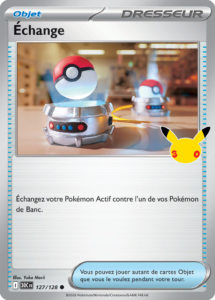
- Play Trainer cards: as many Items as you like, but only one Supporter and one Stadium per turn.
- Retreat once per turn: discard as many Energy as your Active Pokémon’s Retreat cost, then swap it with a Pokémon on your Bench.
- Use Abilities, the powers some Pokémon have in addition to their attacks, following the card’s text.
3. Attack
To attack, your Active Pokémon must have the Energy shown in the attack’s cost (it stays attached; you don’t discard it). Then apply the attack’s damage and effects. Attacking ends your turn, so get everything else ready first. Attacking is optional: you can also end your turn without doing so.
Between turns comes the Pokémon Checkup, where Special Conditions such as Poison apply. We’ll look at it in detail in lesson 5.
The special first-turn rule
A first turn, step by step
Léa won the coin flip and chose to go first. She placed Riolu in her Active Spot. In her hand: a Fighting Energy, a Nest Ball, a Switch, a Supporter card and two other cards.


- She draws her card for the turn.
- She plays Nest Ball, an Item that lets her search her deck for a Basic Pokémon and put it directly onto her Bench. Her team fills out.
- She attaches the Fighting Energy to Riolu. It’s her only Energy for the turn.
- She keeps her Supporter: she can’t play it, since she goes first.
- She doesn’t attack (not allowed on the first player’s first turn) and announces the end of her turn.
On Tom’s turn, anything goes: he can play a Supporter, attach an Energy and attack if he can pay an attack’s cost.
Knocking Out and taking your Prizes
When the damage placed on a Pokémon reaches or exceeds its HP, it is Knocked Out: it goes to the discard pile with all the cards attached to it. Its opponent then takes one or more Prize cards, depending on the Pokémon that was Knocked Out:
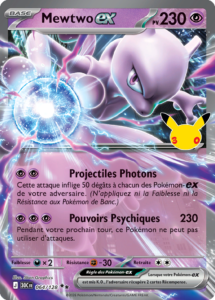
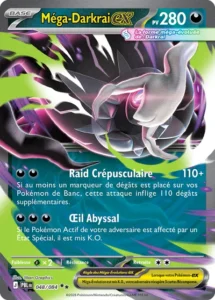
The player whose Active Pokémon was Knocked Out must immediately replace it with a Pokémon from their Bench. If they can’t, they lose the game.
Testez-vous
What does a player do who has no Basic Pokémon in their starting hand?
They show their hand to their opponent, shuffle it into their deck and draw 7 new cards. The opponent may draw an extra card for each mulligan.
Can the player who goes first attack on their first turn?
No. The player who goes first can neither attack nor play a Supporter on their first turn.
Can you play several Item cards in the same turn?
Yes: as many Items as you like. It is the Supporter and the Stadium that are limited to one per turn.
Why must you get everything ready before attacking?
An attack ends the turn: you must attach your Energy, play your Trainers and evolve before attacking.