

Twenty cards is three times fewer than a deck in the classic TCG. Every slot counts, and an unbalanced deck shows its flaws by the second turn. Here is a simple method, usable with any featured Pokémon, for building a deck that draws well and attacks fast.
- Size
- exactly 20 cards
- Copies
- 2 maximum per card name
- Energy types
- 1 to 3 (1 recommended)
- Energy cards
- none
- Featured card
- your choice, shown at the top of the deck
Deck-building rules
A deck contains exactly 20 cards, Pokémon and Trainers. You can include at most two cards with the same name: two Pikachu and two Pikachu ex, for example, are allowed because their names differ. Different rarities of the same card count as the same name: a ★★ version and a ♦♦♦♦ version of Mewtwo ex make two copies. When you save the deck, you choose the Energy types the Energy Zone will generate, its featured card, and its accessories (card sleeves, play mat, coin).The typical skeleton
Most competitive decks follow a split close to this one:
- 8 to 12 Pokémon: one or two main attackers, their evolutions, and possibly a support Pokémon (a useful Ability, a backup attack).
- 8 to 12 Trainers: draw, Pokémon search, healing, mobility and Supporters suited to your type.
The more your Pokémon evolve, the more Trainer cards you need to find the right cards at the right time.
Step 1: choose your attacker
Every deck starts with a Pokémon that can deal a lot of damage quickly. Ask yourself three questions:- How much Energy does it need? Two Energy means an attack by turn three. Four Energy is often too slow without acceleration.
- Is it a Basic Pokémon? A Basic attacker enters play right away. A Stage 2 Pokémon takes three cards and two turns of setup.
- How many points does it give up? A Pokémon ex gives your opponent 2 points, a Mega Pokémon ex gives 3. The riskier it is, the more it needs protection.
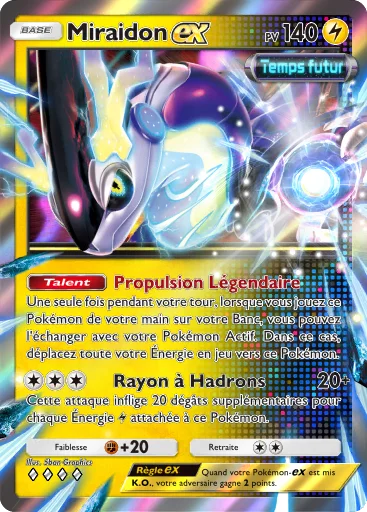
Example: Miraidon ex
Fast: Basic Pokémon
It enters play and strikes right away thanks to its Ability that recovers your Energy. Ideal for applying pressure from the start.
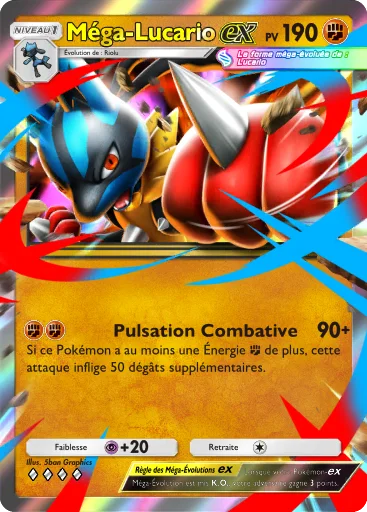
Example: Mega Lucario ex
Balanced: Stage 1
Just one evolution to play, an attack with two Energy: a solid compromise between speed and power.
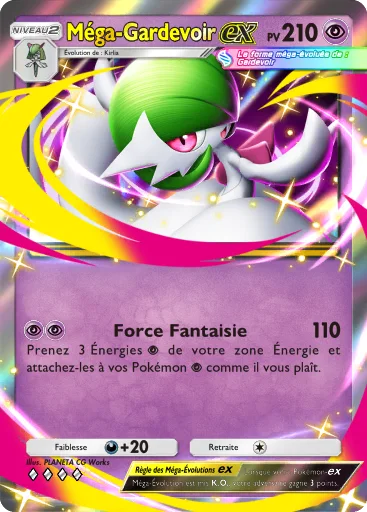
Example: Mega Gardevoir ex
Powerful: Stage 2
Slower to set up, but capable of turning a game around. It needs support to buy the time required.
Step 2: evolution lines
For a Stage 1 Pokémon, count on 2 Basic Pokémon and 2 evolutions. For a Stage 2, the “2-2-2” line is the safest, but it takes up six slots. Many players settle for a “2-1-2” or a “2-2-1” to free up room.Step 3: essential Trainer cards
These shop cards appear in nearly every deck. Start with them, then add the Supporters specific to your type.| Card | Why play it | Copies |
|---|---|---|
| Professor’s Research | Draws two cards: the best way to find your evolutions. | 2 |
| Poké Ball | Adds a Basic Pokémon to your hand. | 2 |
| Potion | Heals 20 damage, often enough to survive an attack. | 0 to 2 |
| X Speed | Reduces the Retreat Cost so you can replace the Active Pokémon. | 0 to 1 |
| Red Card | Disrupts your opponent’s hand late in the game. | 0 to 1 |
Step 4: Energy types
Choosing a single Energy type guarantees that every Energy generated will be useful. Two types are only justified if your attackers truly need them, for example for Dragon Pokémon, which often require two different Energy types. Three types make the deck very inconsistent.Step 5: test and adjust
Test your deck against the computer, then in a friendly or ranked battle. Note what you miss most often: your evolutions (add more draw), a replacement for the Active Spot (add Basic Pokémon), or damage to finish off opposing Pokémon ex (add Giovanni or a second attacker).A worked example
Here is the structure of a deck built around Mega Lucario ex, a Stage 1 Fighting-type Mega Pokémon ex from the Pulsing Aura expansion.| Role | Cards | Count |
|---|---|---|
| Main attacker | Riolu + Mega Lucario ex | 2 + 2 |
| Second attacker | A Basic Fighting Pokémon that attacks early | 2 |
| Draw | Professor’s Research | 2 |
| Search | Poké Ball | 2 |
| Supporters | One damage Supporter and one mobility Supporter | 2 + 2 |
| Healing and mobility | Potion, X Speed | 2 + 1 |
| Tools | A Cape or a defensive Tool | 2 |
| Energy | Fighting only | — |
 Battle rulesEnergy Zone, points, a Bench of three Pokémon: the whole flow of a game.
 Types and WeaknessesThe ten Energy types, the +20 damage rule and dual-type Pokémon.
 Trainer cardsItems, Supporters, Tools and Stadiums: the cards that win games.
 Decks and archetypesThe main deck families and the cards to build around.