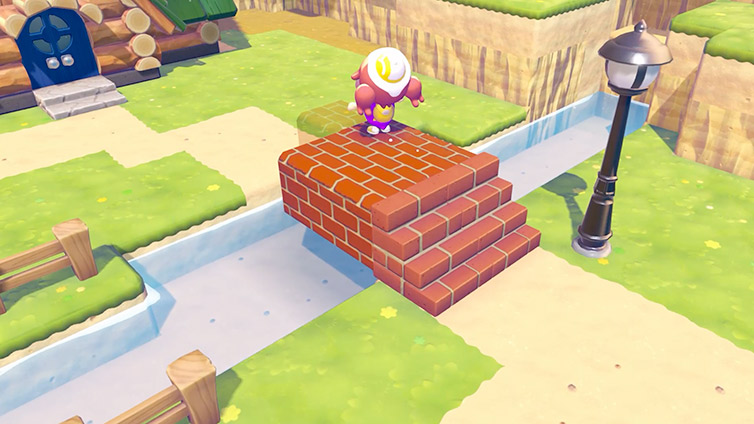
Rebuilding an entire world takes tools, furniture and buildings, and in Pokémon Pokopia almost everything comes down to crafting. This guide explains how the workbench and crafting recipes work, where to find and how to process key materials, how to complete building kits, and how to add color to your creations with Smearguru.
Contents
- The workbench and crafting recipes
- Key materials and how to get them
- Building with kits
- Painting with Smearguru
- Trading, collecting and electricity
- Tips
The workbench and crafting recipes
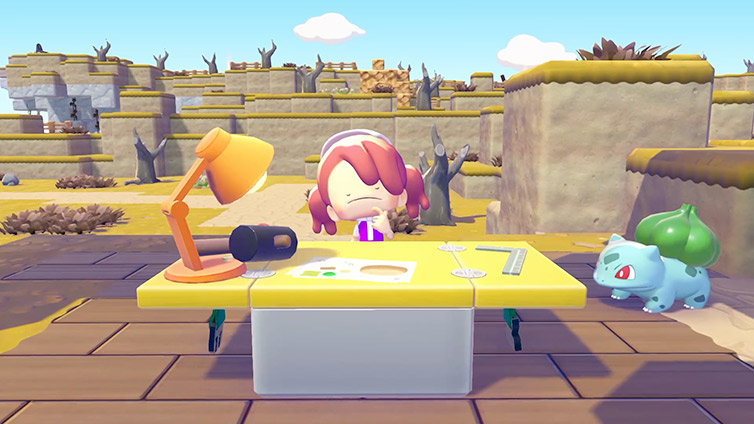
Crafting relies on three things: a workbench, recipes and materials. You get your first workbench early in the adventure, after meeting  Bulbasaur ; the recipe for making more is then sold in the shop. At the workbench, pick the item and the quantity you want: crafting is instant and the item goes straight into your inventory.
Without a recipe, you can’t craft an item, even with all the materials in your pocket. Recipes can be obtained in several ways:
- In the shop, through the PC at the Pokémon Center, with new recipes unlocked at each Environment Level.
- As a reward for Pokédex progress and for some Requests.
- In the world: some are lying next to a workbench in the ruins, while others turn up at random when you dig into ripples in the water.
- As limited offers in the shop, which regularly refreshes part of its catalog.
Key materials and how to get them
Basic materials are gathered straight from nature, often thanks to Ditto’s moves: Cut for trees, Rock Smash for stone and ore, Leafage for vegetation. More advanced materials need processing, often with the help of a Pokémon and its specialty:
| Material | How to get it |
|---|---|
| Wood | A Pokémon with the Chop specialty turns small logs into wood. You can also find it on the Dream Islands and by dismantling old furniture. |
| Copper, iron and gold ingots | Smelt the matching ore in a furnace. The metal furnace, which is more efficient, is bought as a recipe. |
| Pokémetal | Smelt Pokémetal fragments in the furnace. It is also sold in the shop from Environment Level 6. |
| Rare Pokémetal | Smelt rare Pokémetal fragments. The Rarify specialty also lets you trade a Star Piece for an ingot. |
| Glass | Smelt sand or volcanic ash in the furnace, or break windows. |
| Brick | Hand pliable clay to a Pokémon with the Burn specialty. |
| Concrete | Put limestone in a concrete mixer operated by a Pokémon with the Crush specialty. |
| Paper | Hand scrap paper to a Pokémon with the Recycle specialty. |
Keep the Dream Islands in mind too: depending on the plush toy you show to  Drifloon, each island is packed with different resources, and every one hides five Pokémetal ingots in a cave.
Building with kits
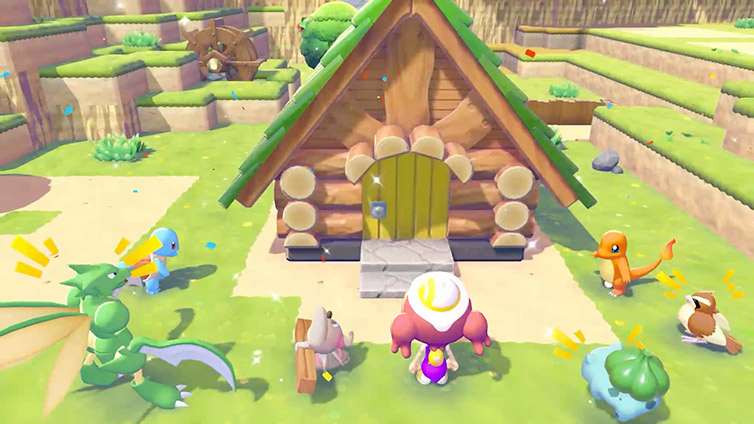
Kits let you build houses, shops and large structures. They can be bought in the shop, found in the wild or given by residents. Place the kit on flat ground with no holes or obstacles (tall grass included) and a construction site appears with a sign. You then need to drop off the requested materials and bring the required Pokémon to the site, some of which must have a specific specialty. Construction then takes real time, from fifteen minutes to a day depending on the building.
| Kit | Materials | Pokémon | Required specialties | Time |
|---|---|---|---|---|
| Leaf Shelter | 3 sturdy branches, 3 leaves | 2 | Build | 15 min |
| Leaf Hut | 15 wood, 15 leaves | 4 | Build, Chop | 1 hr |
| Leaf House | 20 wood, 20 leaves, 20 stones | 6 | Build, Chop, Fly | Next day |
| Sand Shelter | 5 shells, 5 stones, 5 beach sand | 2 | Build | 15 min |
| Sand House | 20 stones, 20 bricks, 20 beach sand, 20 shells | 6 | Build, Water, Generate | Next day |
| Stone Shelter | 5 stones, 10 volcanic ash | 2 | Build | 15 min |
| Stone House | 25 stones, 25 bricks, 25 iron ingots | 6 | Build, Crush, Burn | Next day |
| City Shelter | 5 Pokémetal, 5 wood, 5 stones | 2 | Build | 15 min |
| City House | 20 Pokémetal, 20 glass, 20 bricks, 20 concrete | 6 | Build, Gather, Fly | Next day |
Good news for the impatient: if Tinkmaster, a  Tinkaton with the Engineer specialty, takes part in the construction, any building is finished in an hour at most. Relocation kits, which require a Pokémon with the Bulldoze specialty, let you move an empty building, and demolition kits let you remove it. Each area has a total of 40 construction points, and each kit uses one or two depending on its size.
Building your own house
You don’t have to use a kit. A space counts as a house as soon as it is surrounded by blocks and closed off by a door; no roof is needed. For a Pokémon to agree to move in, it must contain at least three different pieces of furniture, from any category. A house can hold up to four Pokémon; a shelter only houses one, of small or medium size, and a hut houses two. A house build must not exceed 11 × 12 blocks to be recognized as a dwelling.

Painting with Smearguru
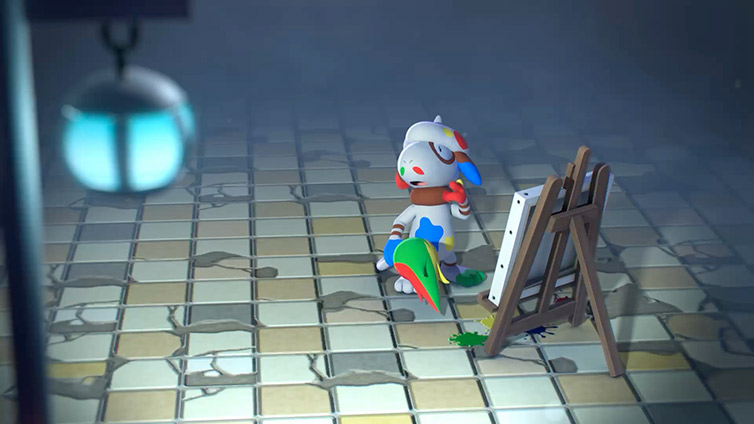
In Bleak Beach, you’ll meet Smearguru, a colorful  Smeargle with the unique Paint specialty: it changes the color of compatible furniture and items. Some items can even be painted in two parts.
Paint can be bought in the shop or made by having a Pokémon with the Crush specialty grind Berries, with each Berry giving its own color:
| Berry ground | Paint obtained |
|---|---|
| Leppa Berry | Red (sometimes white as a bonus) |
| Chesto Berry | Blue (sometimes white) |
| Pecha Berry | Pink (sometimes black) |
| Rawst Berry | Cyan (sometimes black) |
| Aspear Berry | Yellow (sometimes black) |
| Lum Berry | Green (sometimes white) |
By mixing these base paints, you get 18 shades in total. Paint balloons, which you buy and then craft, also let you paint things yourself by throwing them at objects.
Trading, collecting and electricity
- Trading: a Pokémon with the Trade specialty will run a shop as soon as it has a powered cash register and a counter. Offer it up to four types of items to reach the requested value; items that match its tastes count for more. It’s a good way to get materials, Berries missing from your save or rare items.
- Collecting:
 Gimmighoul and
 Gholdengo trade the feathers of Ho-Oh and Lugia (Rainbow Wing and Silver Wing) as well as identified lost items for rare furniture and materials you can’t find anywhere else.
- Electricity: many items, including some habitat elements, need to be powered. Several generators exist, including the furnace, which has to be restocked. Power is distributed through electric poles, then through wireless transmitter pads, unlocked by a Request from Porygon in Sparkling Skylands. Plugging in too many devices for the available output causes a short circuit that cuts power to the whole network.
Tips
- Set up several workbenches and storage chests in each area: you’ll save precious time during big building sessions.
- Always dig into ripples in the water: they hide random crafting recipes.
- Build up a stockpile of ingots, bricks and concrete early: big construction projects and the legendary bird kits call for them by the dozen.
- Keep Tinkmaster handy for big projects: a day of waiting becomes an hour.
- Check the list of required specialties before starting a kit: a single Pokémon with the specialty is enough, but it has to be on site.
Related guides
Find all our guides in the complete Pokémon Pokopia walkthrough:
- Getting started: the basics and 10 tips
- Story walkthrough, area by area
- All of Ditto’s moves
- Habitat Dex: all 209 habitats and their recipes
- All Pokémon specialties
- Legendary and Mythical Pokémon: how to meet them
- Environment Level, Comfy Level and Mosslax
- Friendship, minigames and best moments
- Cooking and gardening: all the recipes
- Lost items, Human Records and treasure maps
- Dream Islands and Cloud Islands
- Bubbly Basin: access, Dive and habitats
- Pumpkaboo’s Halloween event
- Mystery Gift codes and distributions
Sources: Pokébip (crafting), Pokébip (building), Pokébip (specialties), Serebii (crafting), Serebii (building), Serebii (painting), Serebii (trading), Serebii (electricity), official Pokémon Pokopia website. Image credits: © The Pokémon Company / Nintendo / GAME FREAK / KOEI TECMO (site officiel).