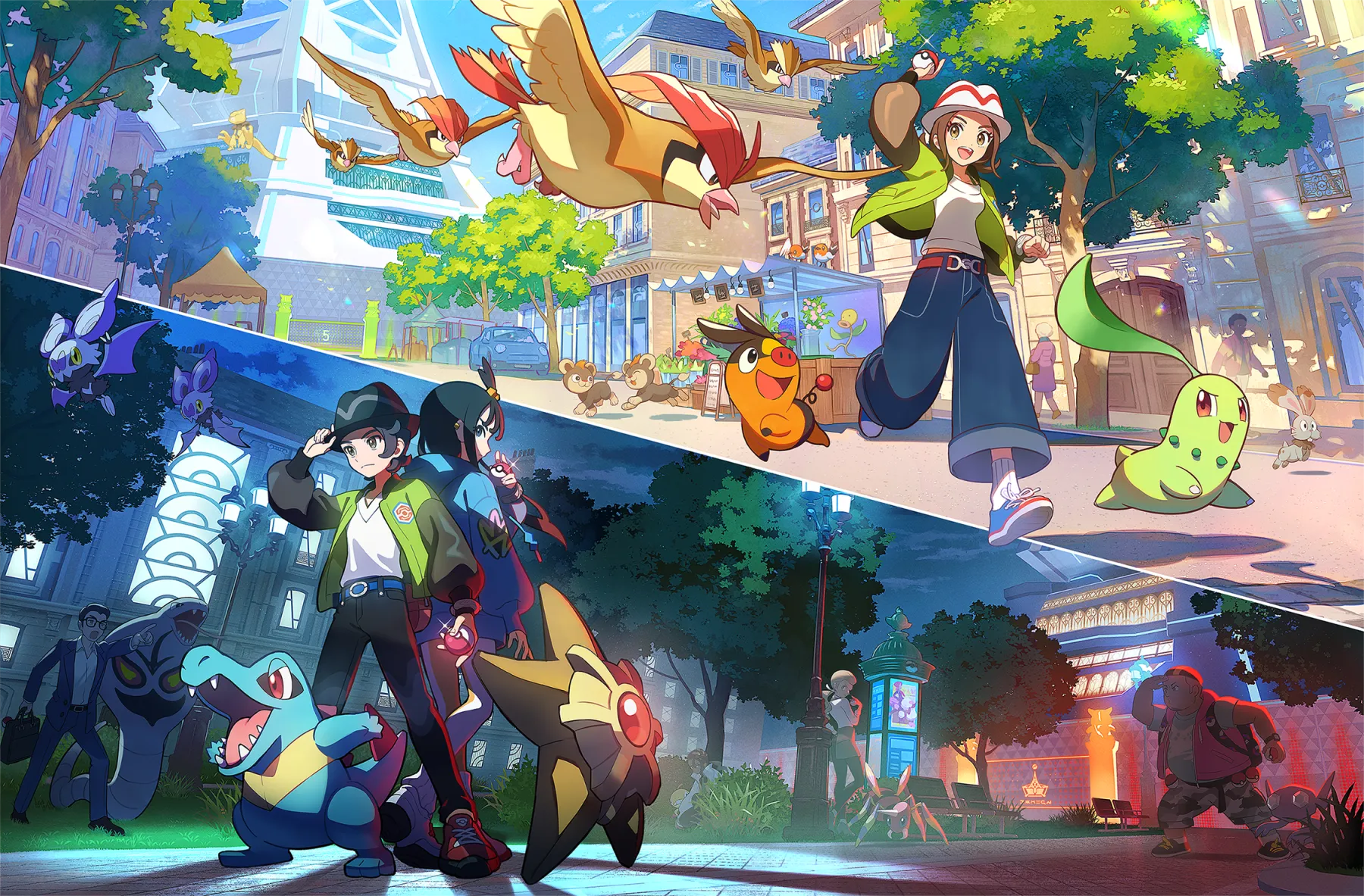
Three years after Pokémon Legends: Arceus, Game Freak is back with a second “Legends” installment. A radical change of scenery: gone are the vast plains of Hisui, replaced by a single city, Lumiose City, explored from top to bottom. And above all, no more turn-based battles. Did the gamble pay off? Our verdict, after the main story, the post-game and the Mega Dimension expansion.
Legends Z-A finally dares to blow up Pokémon combat, and it works. Lumiose City is a dense, vertical playground, Mega Evolution has never been so exhilarating and the cast is endearing. A single city that ends up going in circles and technical shortcomings, especially on the original Switch, keep it from reaching the heights.
- A nimble, readable and deep real-time battle system
- The Rogue Mega Evolution battles, spectacular and demanding
- The Z-A Royale, an addictive day/night loop
- Lumiose City, dense, vertical, full of rooftops to explore
- 26 new Mega Evolutions, and 19 more in the expansion
- An endearing Team MZ and memorable rivals
- A single city: the settings end up looking alike
- Dated visuals, especially on Switch 1 (unstable 30 fps)
- A slow, very hand-holding start to the adventure
- Wild Zones that are too small and too closed off
Lumiose City, a vertical playground
The whole adventure takes place in the capital of Kalos, redeveloped by Quasartico Inc. five years after Pokémon X and Y. The gamble of a single city was cause for concern; it largely succeeds thanks to its verticality. The rooftops form a second network of streets, with ladders, jumps, Mega crystals and shortcuts, and it’s a real pleasure to play the acrobat between missions. The five districts each have their own color, squares and cafés, and night literally transforms the city.
The flip side: after walking the same Haussmann-style avenues over and over, weariness creeps in during the second half of the adventure. And the Wild Zones, those holographic enclosures that replace routes, are too small to recapture the sense of freedom of Legends Arceus. We would have liked a few escapes outside the city.
Combat, finally reinvented
This is the game’s great success. Battles play out in real time: your Pokémon moves around, each move has its cooldown, range and positioning matter, and your character has to dodge too. After a few minutes of adjustment, there is no going back. Plus moves and the Mega Power gauge add a real layer of management: should you spend a segment now, or keep the gauge full to Mega Evolve? The system stays readable, and the absence of Abilities simplifies the calculations without making battles any poorer.
The Rogue Mega Evolution battles are the game’s showpieces: giant Pokémon that target you as much as your team, charged attacks that cover the arena, distinct phases. The final battle against the Angel is one of the most spectacular in the series. Our only regret: the camera sometimes struggles to keep up in the busiest battles, and opposing Trainers’ AI remains basic.
The Z-A Royale, an addictive loop
By day, you explore, catch Pokémon and chain missions; by night, you slip into the battle zone to surprise Trainers, pick up bonus cards and earn a challenge ticket. This alternation gives a very pleasant rhythm, and the qualifying matches against colorful characters (Narica the streamer, Nivis the karateka, Corvault the elegant godfather, Violine the socialite) are a worthy replacement for Gyms. Surprise attacks, rewarded by the points system, encourage stealth play.
A story that takes its time
The first hours are slow and very hand-holding, interspersed with long conversations. But the story takes off in its second half, skillfully weaving links with Pokémon X and Y: A.Z., the ultimate weapon, Team Flare, Zygarde… Team MZ makes for an endearing band, and the finale is truly epic. With its 42 main missions and 203 side missions, expect around thirty hours for the story and much more to complete everything.
A two-speed technical performance
On the original Switch, the game targets 30 frames per second without always holding them, with a resolution that drops very low in handheld mode, Pokémon and passersby that animate in slow motion in the distance, and elements that pop in late. On Switch 2, the experience changes completely: a stable 60 frames per second, a noticeably sharper image, improved shadows and reflections. Some textures remain poor and facades sometimes lack detail, but the art direction and the music, which revisits the Kalos themes, make up for a lot. Our comparison: Switch or Switch 2?
Mega Dimension, a generous expansion
The expansion adds a mirror city, Hyperspace Lumiose, explored in short incursions thanks to Anya’s and Hoopa’s Donuts. Level 100 to 200 Pokémon, 132 additional species, 19 Mega Evolutions and an avalanche of legendary Pokémon: the content is plentiful. Progression, based on accumulating research points, does become repetitive, however, and cooking Donuts takes a bit of patience to master.
In summary
Pokémon Legends: Z-A is the game that finally gets the mainline series’ battles moving, and for that alone, it deserves to be played. Its single city and imperfect technical side keep it from masterpiece status, but its battle system, its Rogue Mega Evolution Pokémon and the Z-A Royale loop make it one of the most refreshing installments in recent years. Best played on Switch 2.